
HARE KRISHNA ON 19TH STREET
They Arrived Before the Party Diid.
By Jim TowersMJA.JD.
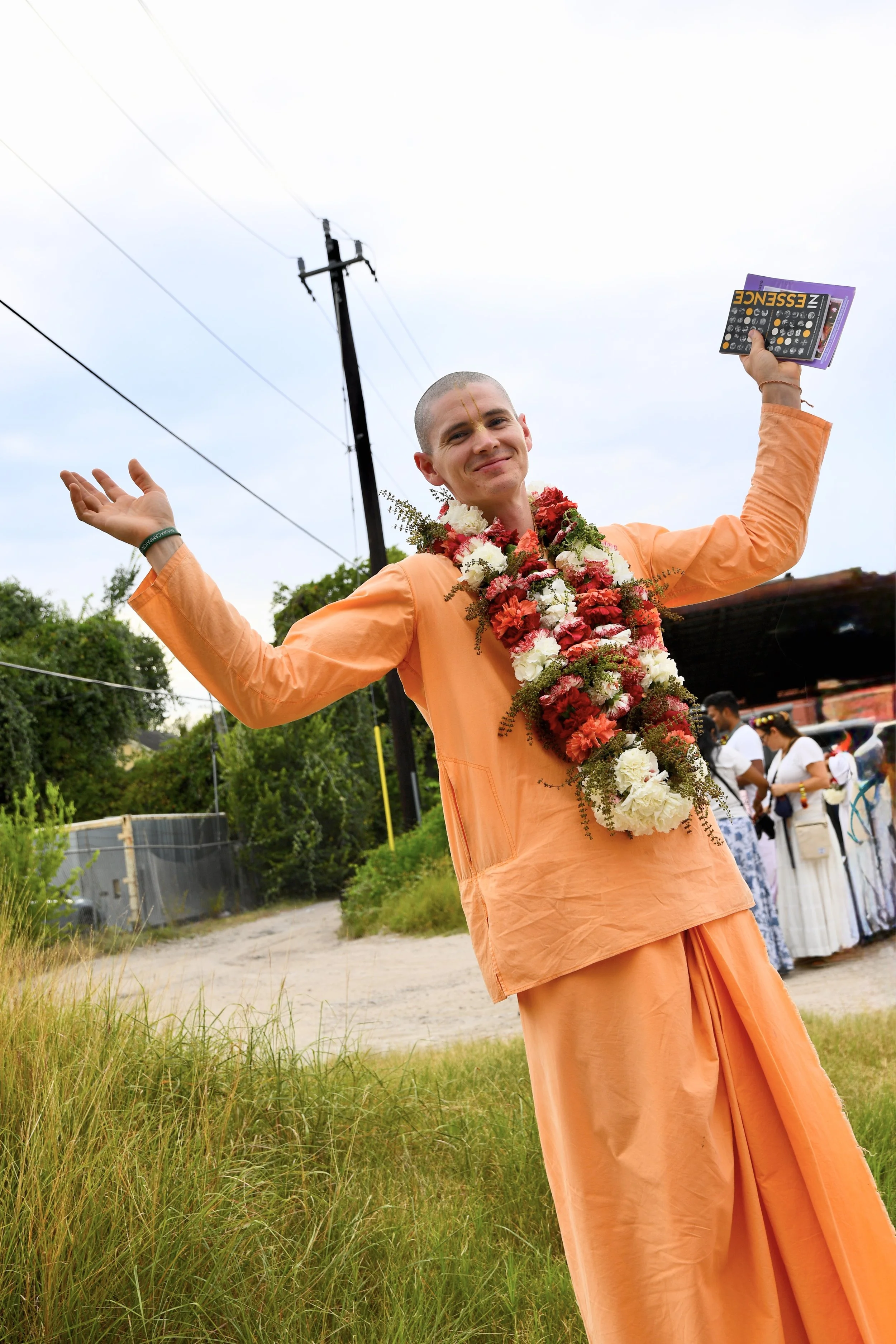
A member of the Houston Hare Krishna community welcomes visitors to White Linen Night on West 19th Street. Photograph by Jim Towers / Houston Heights Independent
They found us before we found them.
Before the food trucks. Before the bands. Before the sea of white linen moving through 108-degree heat on West 19th Street, the Hare Krishnas were already there — standing at the edge of a gravel parking lot with drums and garlands and open hands, ready to meet whoever came their way.
They offered peanut butter candies wrapped in foil. They offered leis they had made themselves — dandelions strung with what appeared to be acorns on a cord, handmade and unhurried, the kind of thing that takes time and intention. They offered a pamphlet about the Heights Krishna temple and the path of bhakti — devotional service, the practice at the center of their faith. They were dressed in full traditional garb: white dhotis, saffron robes, marigold garlands, a flower crown on one of the women. Their mridanga drum was going. Their harmonium was ready.
They were, in a word, delightful.
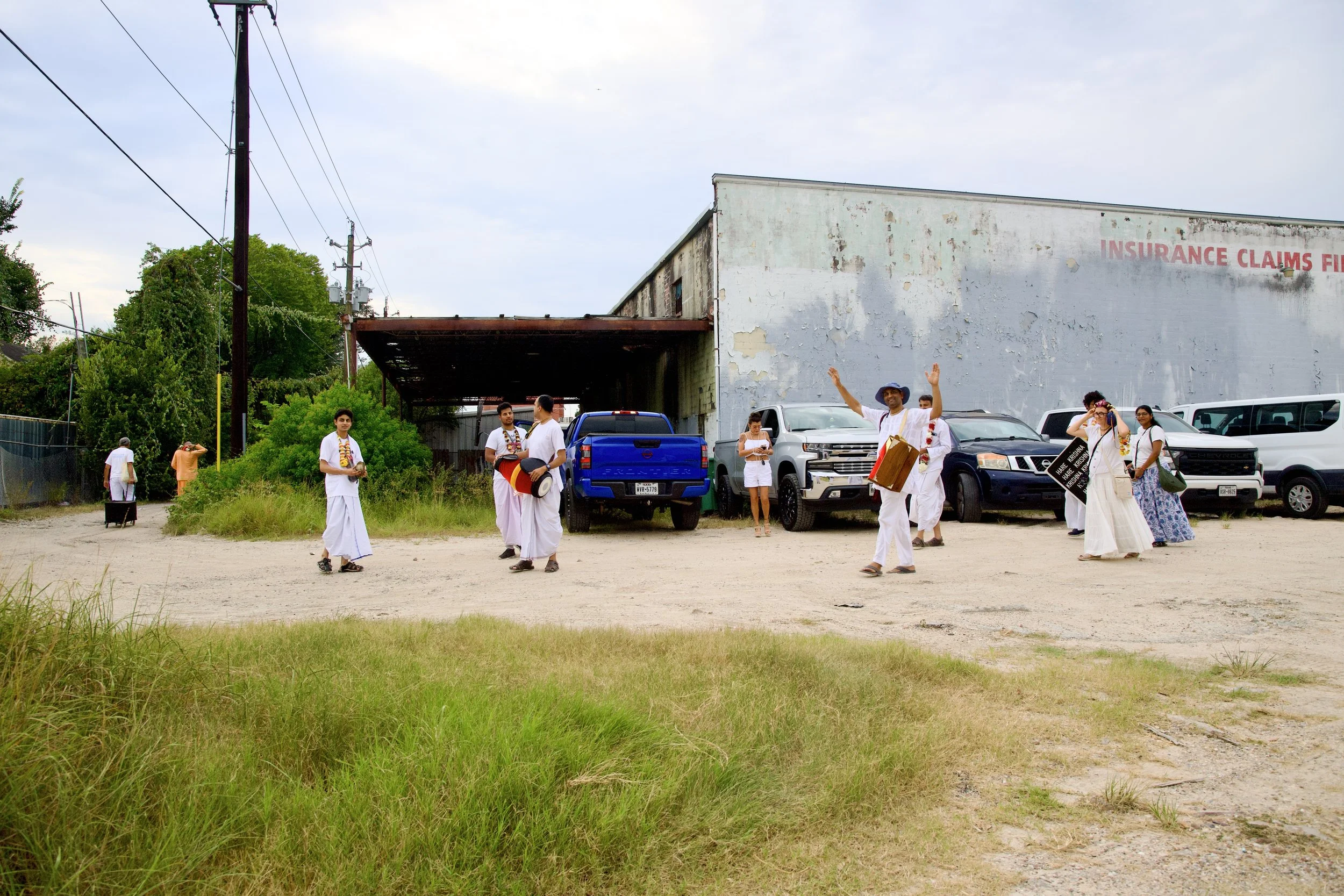
The Hare Krishna movement — formally the International Society for Krishna Consciousness, founded in New York City in 1966 by A.C. Bhaktivedanta Swami Prabhupada — is one of the more misunderstood traditions in American religious life. The saffron robes and shaved heads have made them a fixture of airport mythology and pop-culture caricature for sixty years. What gets lost in the caricature is the actual theology: a Vaishnava Hindu tradition rooted in the Bhagavad Gita and the Bhagavata Purana, centered on devotional love for Krishna as the supreme personal God. The maha-mantra — Hare Krishna, Hare Krishna, Krishna Krishna, Hare Hare, Hare Rama, Hare Rama, Rama Rama, Hare Hare — is not background noise. It is the practice itself, a form of meditation through sound designed to quiet the mind and open the heart.
The woman holding the sign with the mantra printed on it was not proselytizing in any aggressive sense. She was offering it the way you might offer someone directions — here is something that might help you find your way.
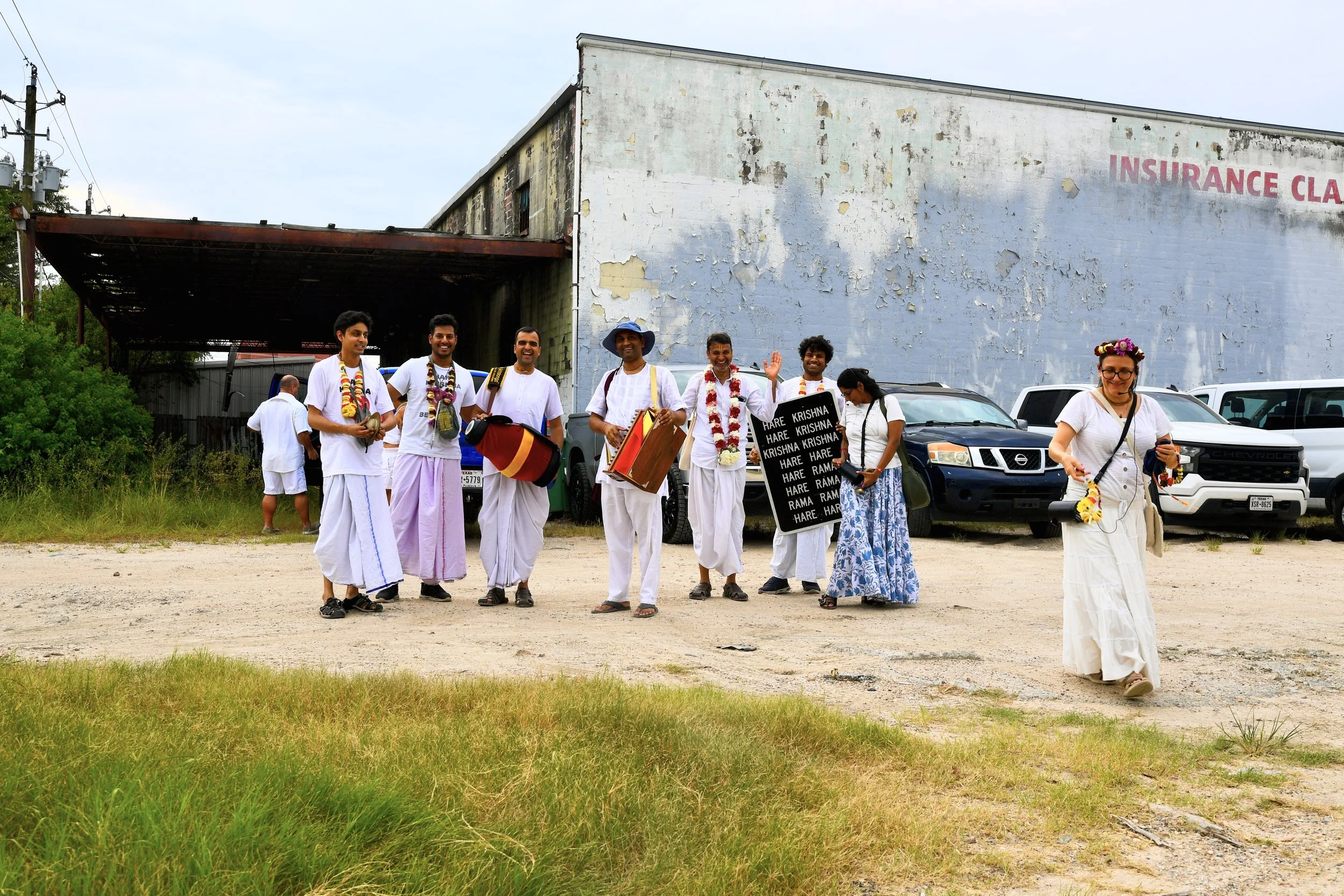
The procession moves toward West 19th Street. The harmonium — a hand-pumped reed organ central to kirtan devotional singing — is a fixture of Hare Krishna practice worldwide. Photograph by Jim Towers / Houston Heights Independent
We talked for a while about the tenets of their faith. They were gracious and genuinely interested in conversation — not in converting, but in connecting. The veganism angle came up naturally: ahimsa, non-harm toward all living beings, is foundational to ISKCON practice. No meat, no fish, no eggs. The peanut butter candies they pressed into our hands were, accordingly, entirely plant-based and entirely good.
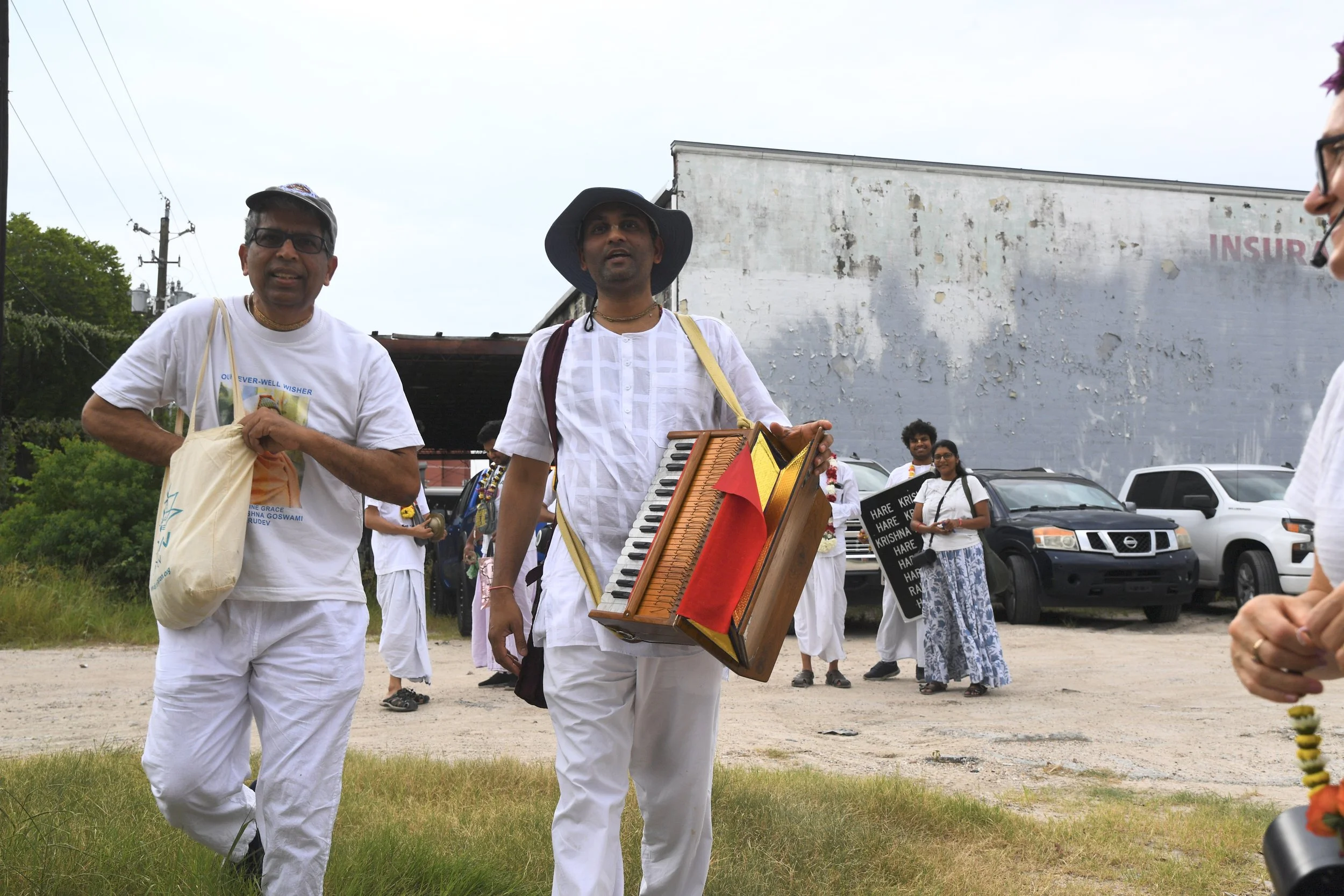
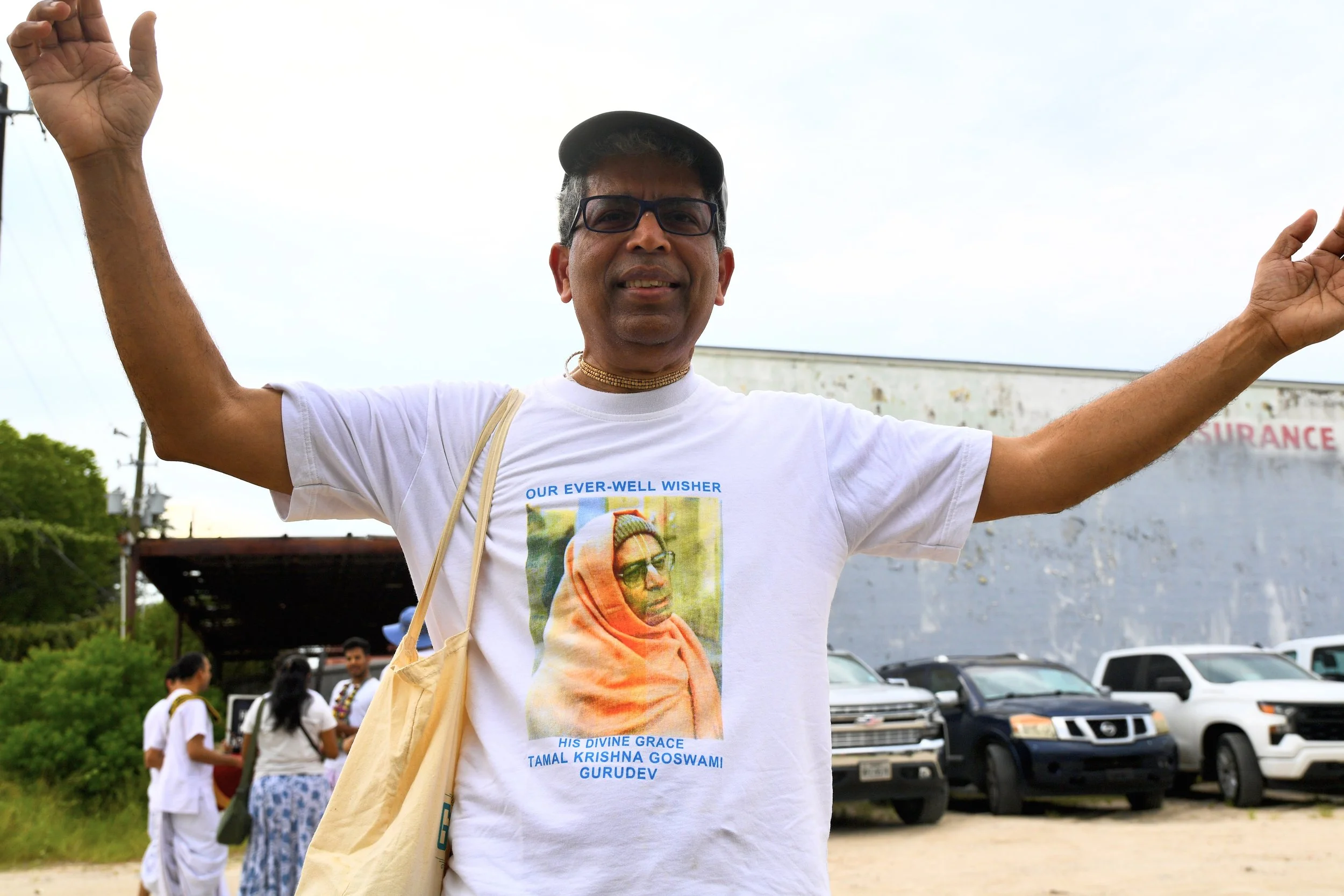
The man wearing the t-shirt bearing the image of His Divine Grace Tamal Krishna Goswami — one of Prabhupada's closest disciples and a figure of deep significance in the ISKCON lineage — carried himself with the quiet certainty of someone who has been practicing a long time and has stopped needing to explain himself to anyone. He raised his arms when he saw the camera. Not for the camera. Just because that is what joy looks like when it has nowhere else to go.
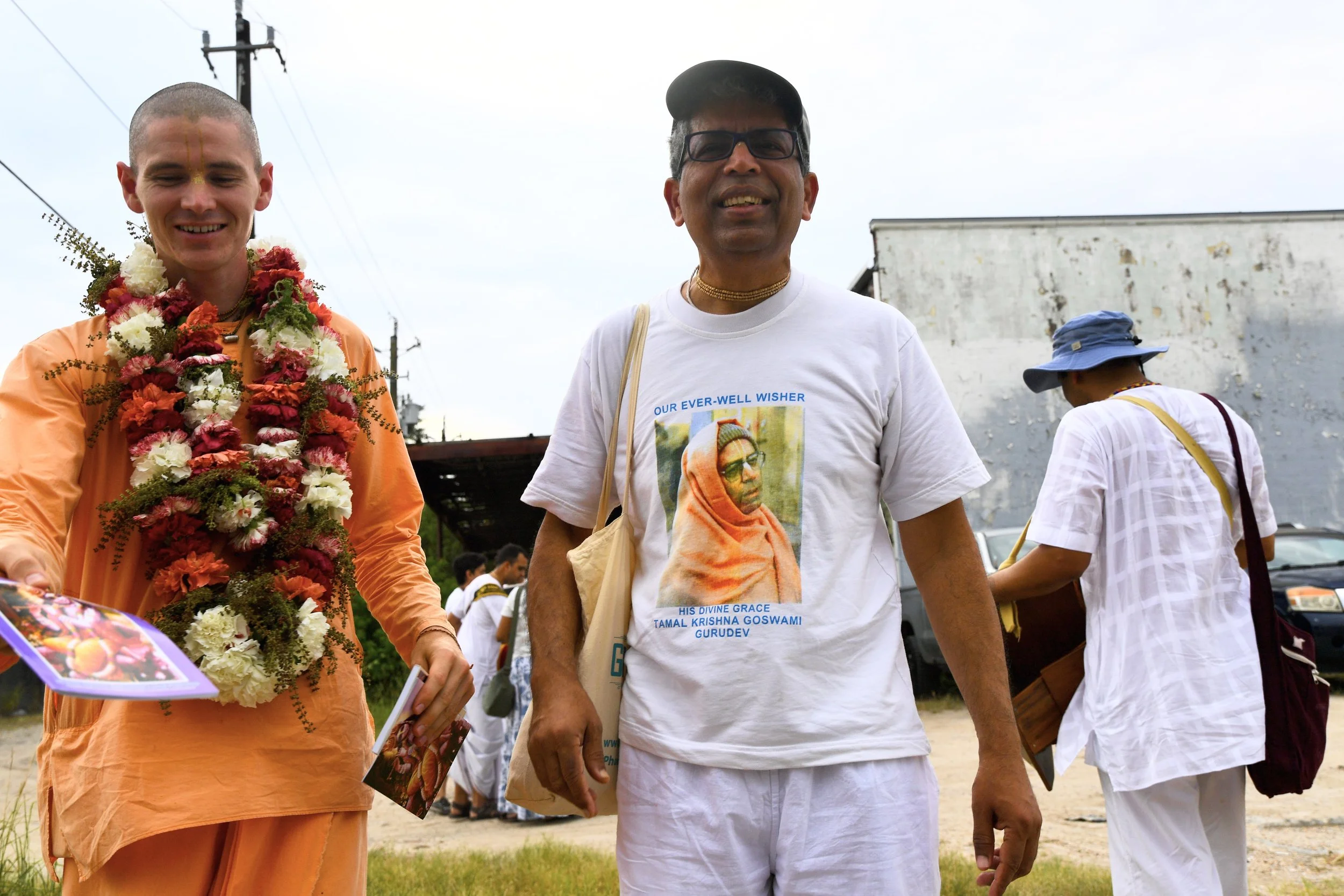
The young monk in saffron was the visual anchor of the whole encounter. Shaved head, tilaka marks on his forehead, a garland of red and white carnations nearly larger than his torso, holding out a small illustrated book the way a child holds out something they made in school — here, this is for you, I made this, I want you to have it. He was American. He was young. He was completely at peace with exactly where he was standing, in a gravel lot adjacent to a peeling warehouse wall, with a party assembling on the other side of the fence.
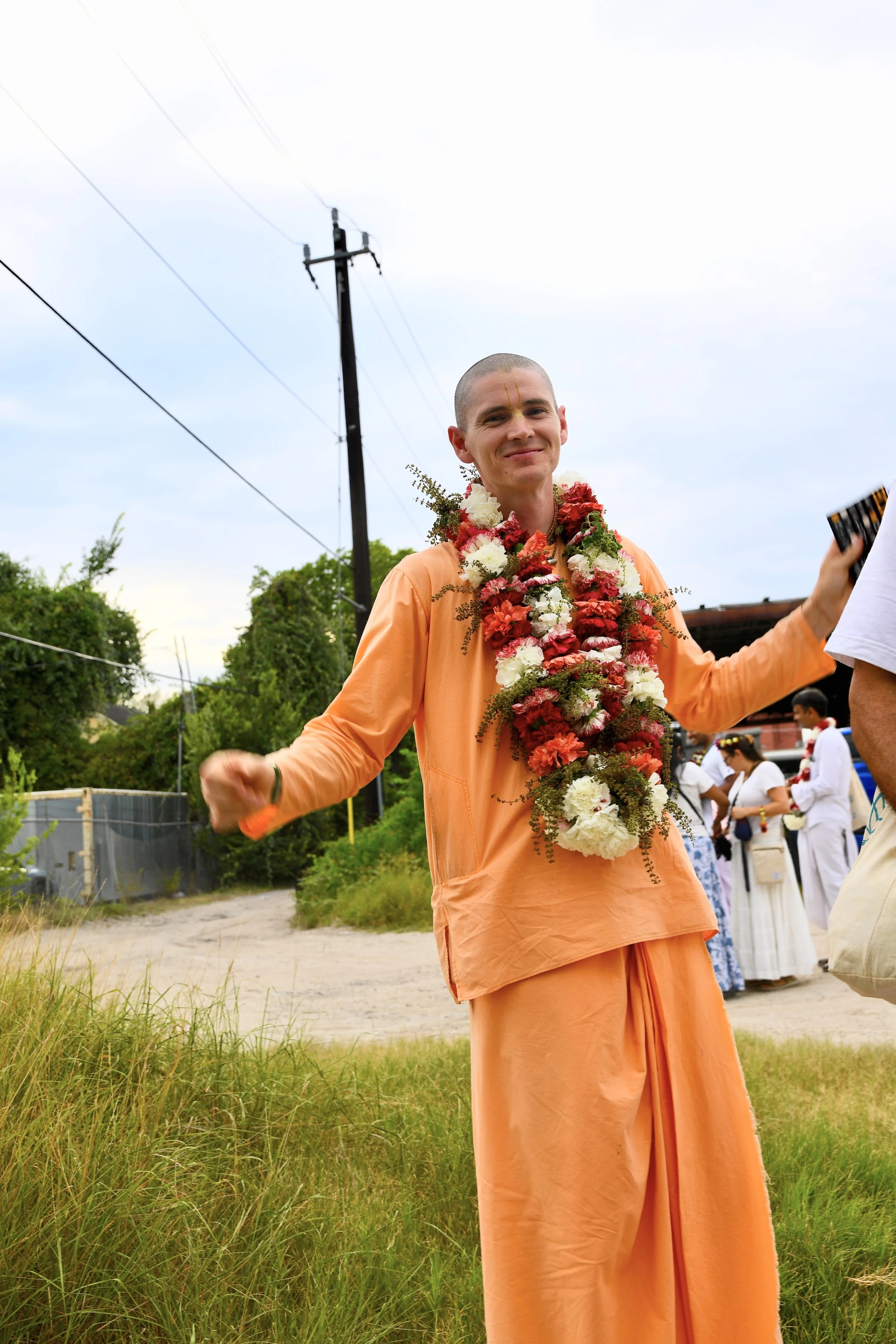
That is the thing about genuine faith. It doesn't need the right backdrop.
The Houston Hare Krishna temple — formally the ISKCON Houston temple, located on Doris Street in the Westheimer corridor — has been part of this city's religious landscape since the 1970s. It runs a Sunday feast open to the public, a Food for Life program that feeds thousands, and outreach efforts across the city that look a great deal like what we encountered on the parking lot edge of White Linen Night: people in traditional dress, moving through the city with instruments and food and an open invitation.
They were at White Linen Night because 19th Street on a Saturday evening in August, with thousands of people in a festive mood, is exactly where you go if your faith teaches that every soul you encounter is a form of the divine and deserves to be met with kindness.
By the time we crossed into the festival itself — food trucks, vendor tents, bands tuning up, the smell of something excellent coming off a Korean-Mexican fusion grill — the drums had already started behind us.
Hare Krishna. Hare Krishna. Krishna Krishna. Hare Hare.
The party had its soundtrack. So did the parking lot. Both were playing at the same time. The Heights has always had room for that.
— Houston Heights Independent | houstonheightsindependent.com
ATTENTION ASSIGNMENT DESKS & MEDIA PRODUCERS:
All text, video, and original photography covering this event are the exclusive property of the Houston Heights Independent. Broadcast, digital replication, or social scraping of these assets without an active license is strictly prohibited. To license clean, high-density, unwatermarked frames for TV broadcast or regional news print, contact our newsroom immediately, at houstonheightsindependent@gmail.com. or 210-288-3034. Standard licensing fees apply.
© 2026 Houston Heights Independent. All rights reserved. Registered under Jim Towers, .MJA.JD. No part of this publication, including text, layout, and original photography, may be reproduced, distributed, broadcast, or transmitted in any form or by any means without prior written permission from the Editor-in-Chief. For media licensing inquiries or syndication requests, contact at houstonheightsindependent@gmail.com. Standard licensing fees apply.
